.svg)
From “Execution” to “Enterprise” Leadership: Rethinking Project Leadership in India’s Infrastructure and Real Estate Sector
.webp)
Beyond Size: The Complexity Shift in India’s Infrastructure & Real Estate
India’s infrastructure and real estate sectors are in a phase of expansion where scale is now accompanied by significantly higher structural complexity. This complexity is emerging along two dimensions: ‘what is being built’ and ‘how it is being delivered’.
Across asset classes, activity is diversifying. Grade A commercial offices, mixed-use developments, premium and luxury residential segments, logistics parks, and urban transport systems are growing quickly.Additionally, data centres, including emerging gigawatt-scale facilities, driven by cloud adoption, AI workloads, and data localisation requirements, are becoming crucial. The surge in semiconductor and electronics manufacturing projects, fuelled by government incentives and digital transformation, further changes the landscape.
Alongside this diversification, there is growing alignment with international standards as construction practices continue to evolve...
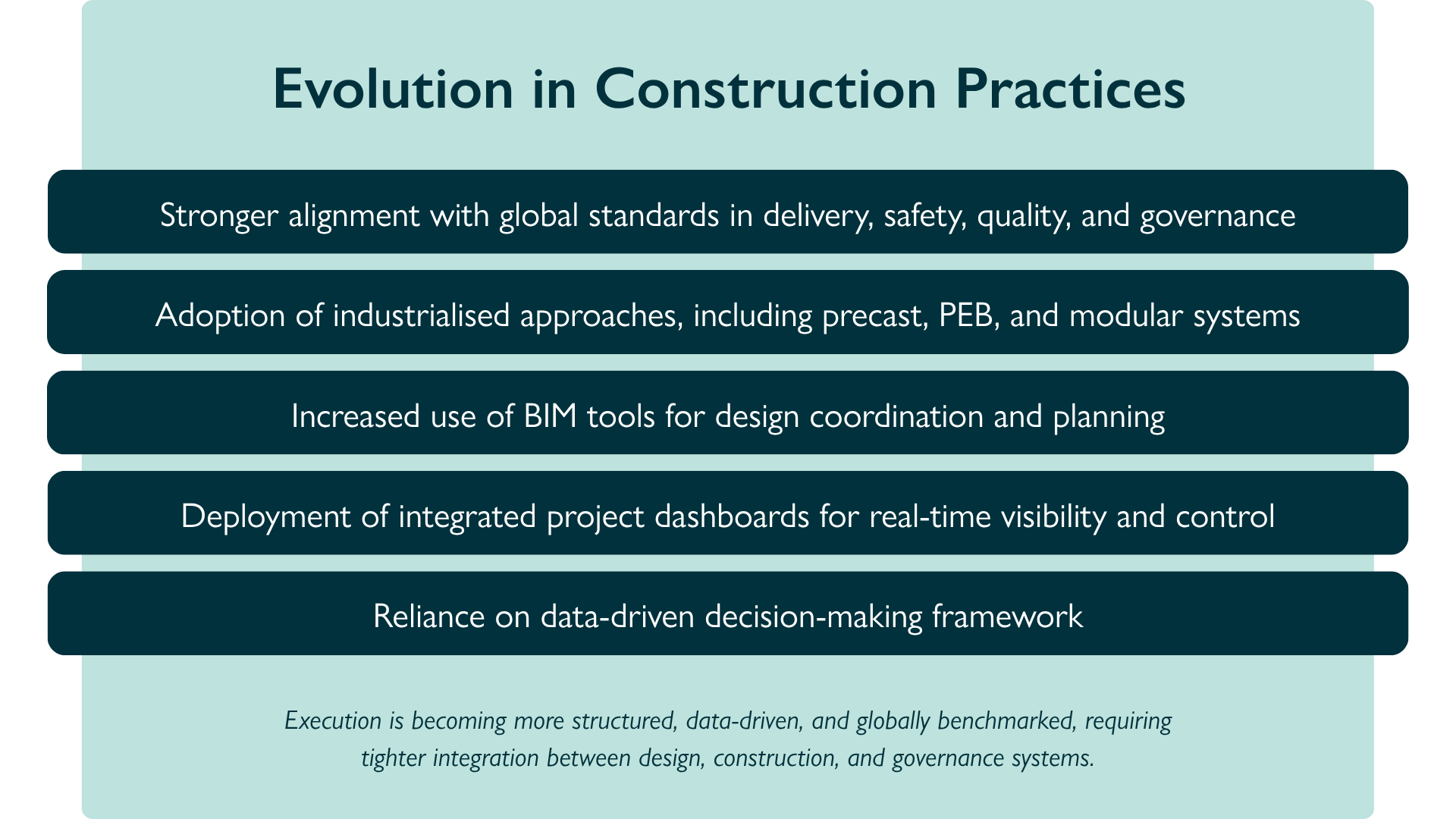
"Success today isn’t just executing at scale – it’s delivering complex projects with technical precision, global standards, and accountable leadership."
Collectively, these trends are redefining the way projects are delivered and the competencies required from leadership in India’s rapidly evolving infrastructure and real estate ecosystem.
Where Projects Break Down: The Decision-Making Bottleneck
Execution capability has long been a strength in India’s project landscape, yet delays and cost overruns persist. The core issues now lie in decision-making throughout the project lifecycle.
Some of the common breakdown points observed across project delivery include delayed design approvals, misaligned procurement sequencing and unresolved commercial changes over extended periods. While decision rights are distributed, accountability tends to remain concentrated at the leadership level. This creates a decision-making bottleneck that slows down projects.
"Execution is not the bottleneck. Decision velocity and alignment under complexity are."
This is also where leadership capability begins to show divergence. Even experienced execution professionals often find it challenging to adapt to environments that require strong commercial judgment, structured risk management, and continuous alignment with multiple stakeholders.
Redefining the Project Director: Leading Beyond Execution
The role of the Project Director is undergoing a structural shift. While technical authority and delivery ownership remain crucial, they are no longer enough.
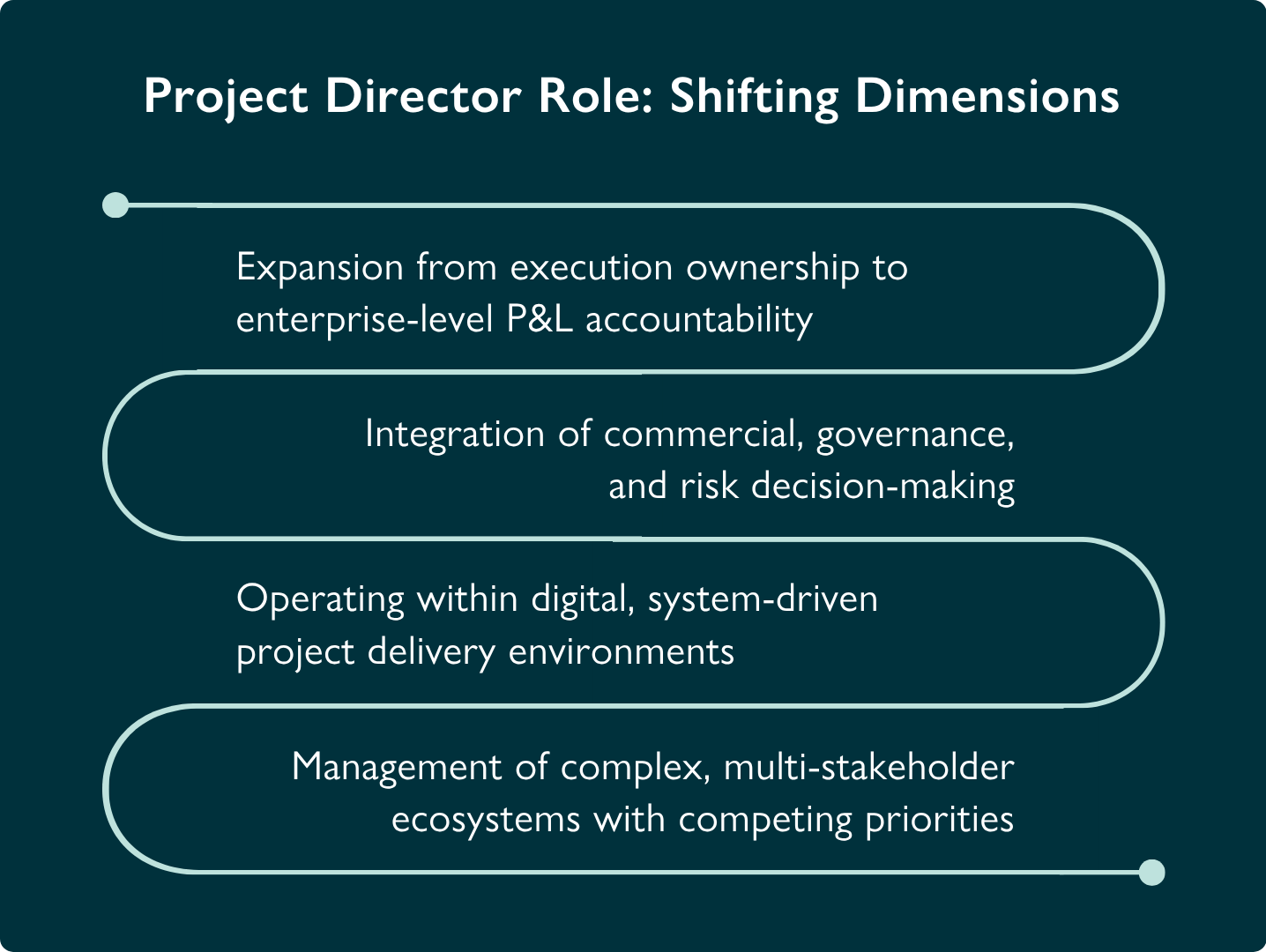
The modern Project Director functions as an enterprise-level P&L owner, integrating commercial accountability, execution rigor, governance, risk management, and stakeholder alignment in digital, system-driven environments. This role requires continuous decision-making under uncertainty, while balancing execution speed, commercial outcomes, and compliance.
"Leadership judgment, not process strength, is becoming the primary differentiator in defining project outcomes."
A key shift lies in the stakeholder environment itself. Project Directors operate within ecosystems that include developers, institutional investors, funding partners, global clients, contractors, and end users, each with differing and often competing expectations. Stakeholder engagement has therefore moved beyond coordination or reporting into a core leadership responsibility that directly influences decision speed and project outcomes. Alongside this, communication effectiveness and risk foresight have become equally critical.
The Leadership Gap and the Compensation Paradox
Despite a strong base of technically capable professionals in India, organizations are encountering a structural gap at the Project Director level. This gap is not about a lack of experience but a mismatch between evolving role expectations and career exposure.
The gap is especially evident in senior level hiring where traditional indicators of strength do not consistently translate into leadership readiness. Profiles that appear strong in terms of project scale or pedigree often fall short in critical areas such as commercial decision-making, handling ambiguity, and enterprise accountability. As a result, leadership hiring at this level is no longer a typical search process. It is an enterprise risk decision.
"Large project delivery experience, in many cases, becomes an imperfect proxy for leadership readiness."
As demand rises for leaders in capital-intensive and institutionally governed projects, top tier talent commands a significant premium, creating a structural compensation challenge. However, compensation alone is insufficient to resolve the underlying gap.
"The real challenge is calibrating leadership investment to project complexity and governance intensity."
There is a risk of over investing in execution driven profiles that lack enterprise decision-making capability. At the same time, not all projects require the same level of leadership depth. The constraint is therefore not only cost but precision in deployment.
Beyond Borders: The Global Talent Imperative
Organizations’ first instinct is to fulfil their leadership needs by tapping into domestic reserves, but the constraints of a limited talent pool are pushing them to broaden their talent pipelines.
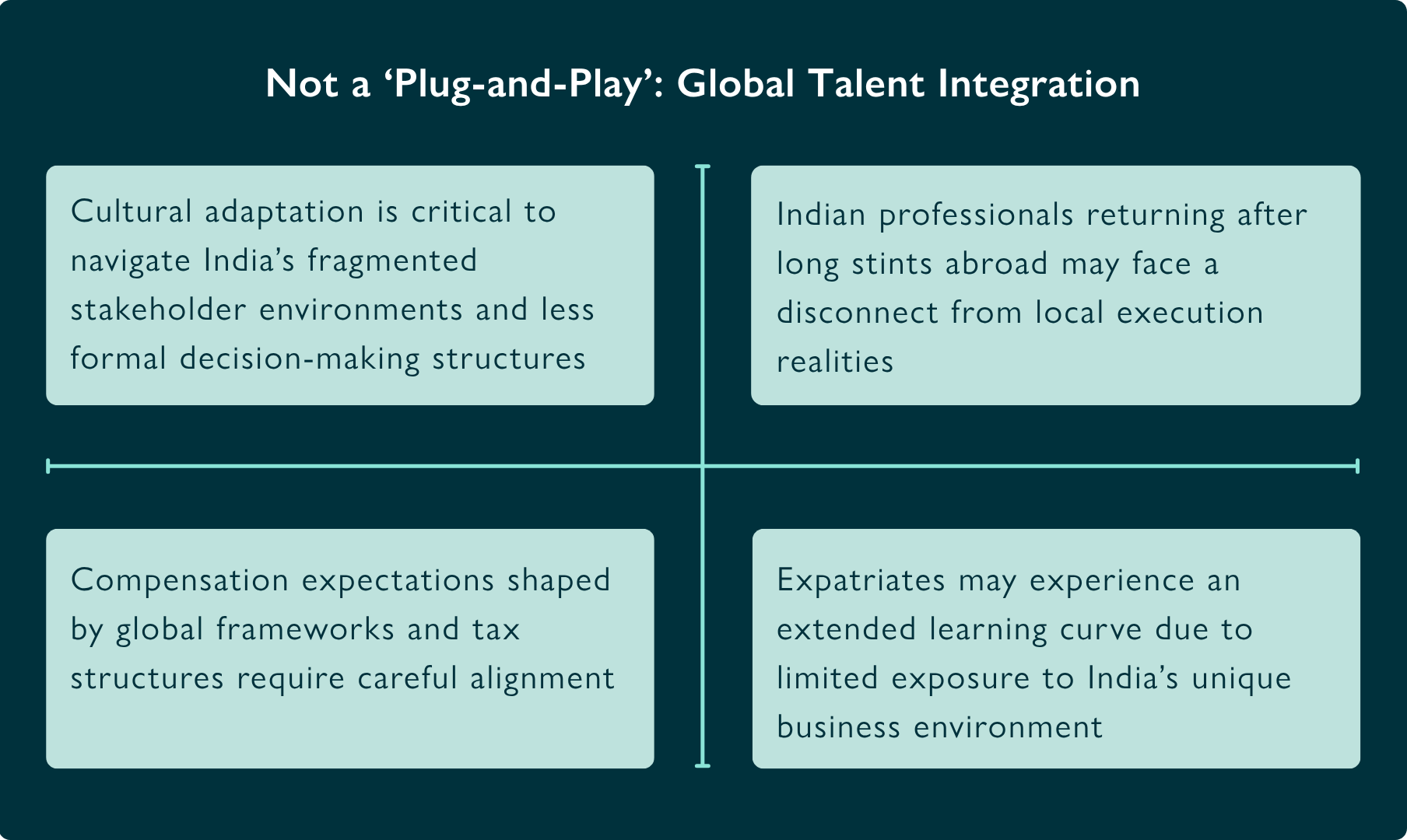
Global talent with large-scale infrastructure and complex real estate project experience remains a key part of the solution, particularly Indian professionals based in the Middle East and Southeast Asia, as well as select international candidates.
"Global talent success ultimately depends on adaptability – to translate global experience into local market context."
Expanding Talent Pipelines: Going Beyond the Norm
Addressing the talent gap requires a broader view of the talent ecosystem and unconventional solutions.
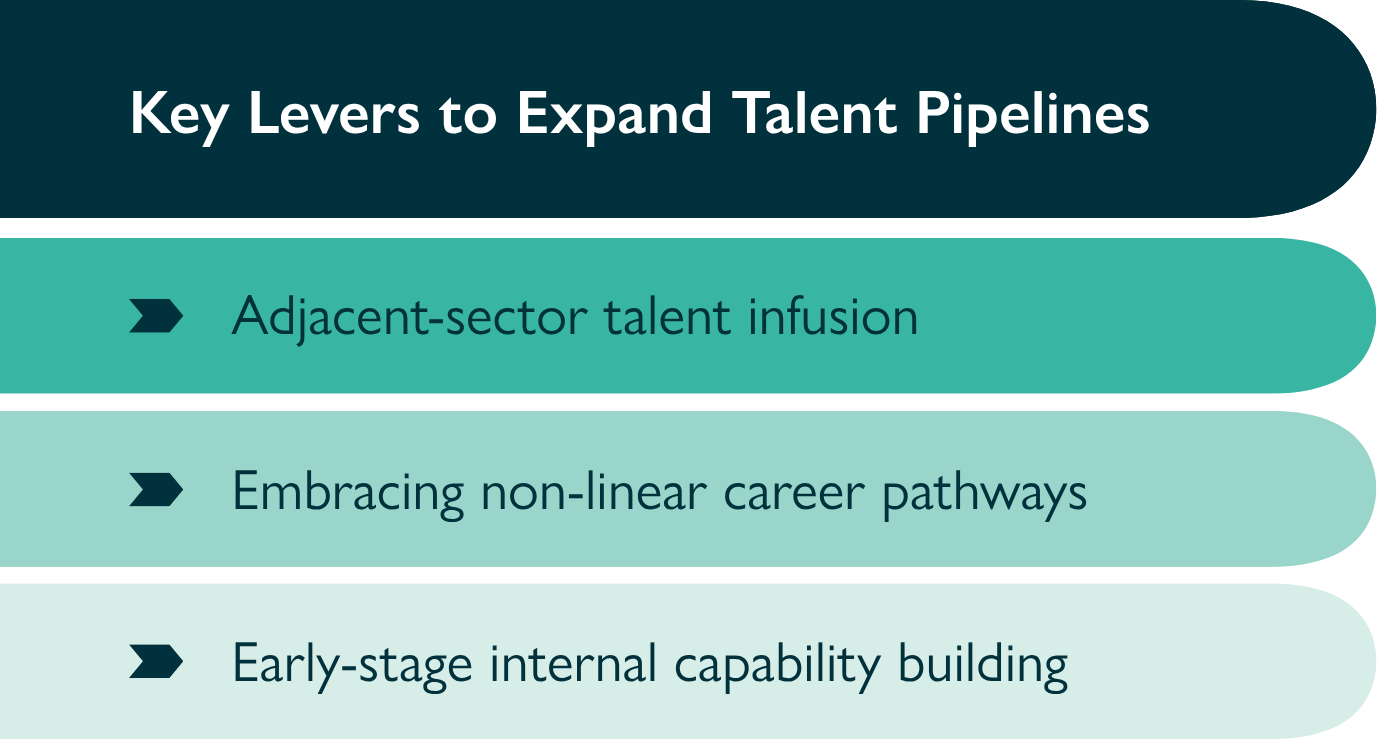
One effective strategy is to look at adjacent sectors that deal with complex project environments, such as oil and gas, telecom infrastructure, renewable energy, and large-scale industrial projects. Leaders from these industries often have experience in managing capital-intensive, high-risk projects, and their leadership capabilities and project management skills can be transferable.
Another approach is embracing non-linear career paths. Professionals who move between commercial and execution roles or from development to delivery functions tend to develop integrated project judgment and stronger trade-off thinking.
"Success in a talent-constrained market comes from unlocking leadership potential where others see unconventional routes."
In parallel, building internal capability is crucial. High-potential talent should be exposed earlier to commercial negotiations, stakeholder complexity, and risk management to develop the leadership depth needed for the future.
Without these approaches, organizations will remain dependent on a structurally constrained external talent pool.
Conclusion: Leadership as the Real Constraint
India’s infrastructure and real estate sectors are not constrained by opportunity, capital, or execution capacity. The real constraint is leadership depth at the decision-making level.
"Execution is not the constraint in India’s infrastructure and real estate growth – leadership depth is."
As projects grow in scale, sophistication, and governance intensity, success will depend on leaders who can integrate execution discipline with commercial judgment, structured risk management, and stakeholder alignment.
The challenge is no longer whether projects can be delivered. It’s whether organizations can identify, attract, and develop leaders capable of making high-quality decisions at the speed and complexity that modern projects demand.
Let’s Connect
At Deininger, an international executive search & leadership consultingfirm, we partner with Boards, Promoters, CEOs / MDs, and CHROs across varied sectors including Infrastructure and Real Estate to advise onorganization-specific leadership strategy as well as to identify and appoint leaders who can navigate the complexities of the market / sector to address the unique needs of our clients.
To explore how a tailored leadership strategy can support your organization's project leadership journey, please connect with Manish Varghese, Managing Director, India & Middle East. He can be reached at manish.varghese@deininger.in



Premiumization has become FMCG's default strategic response, but conviction and execution are rarely the same thing. Over 70% of new launches by large FMCG players are now in the premium segment, yet outcomes remain inconsistent. Angela Thomas, our Partner for Consumer & Retail, explores why premiumization must be treated as a parallel system, not a tactical lever.

Over the next decade in India, the most meaningful luxury investment won’t be in product, pricing, or positioning – but in people. The rarest luxury of all will be leaders who truly understand India. In this blog, Angela Thomas explores the strategic shifts reshaping India’s luxury landscape and outlines what boards and CEOs must consider as they redefine leadership.